

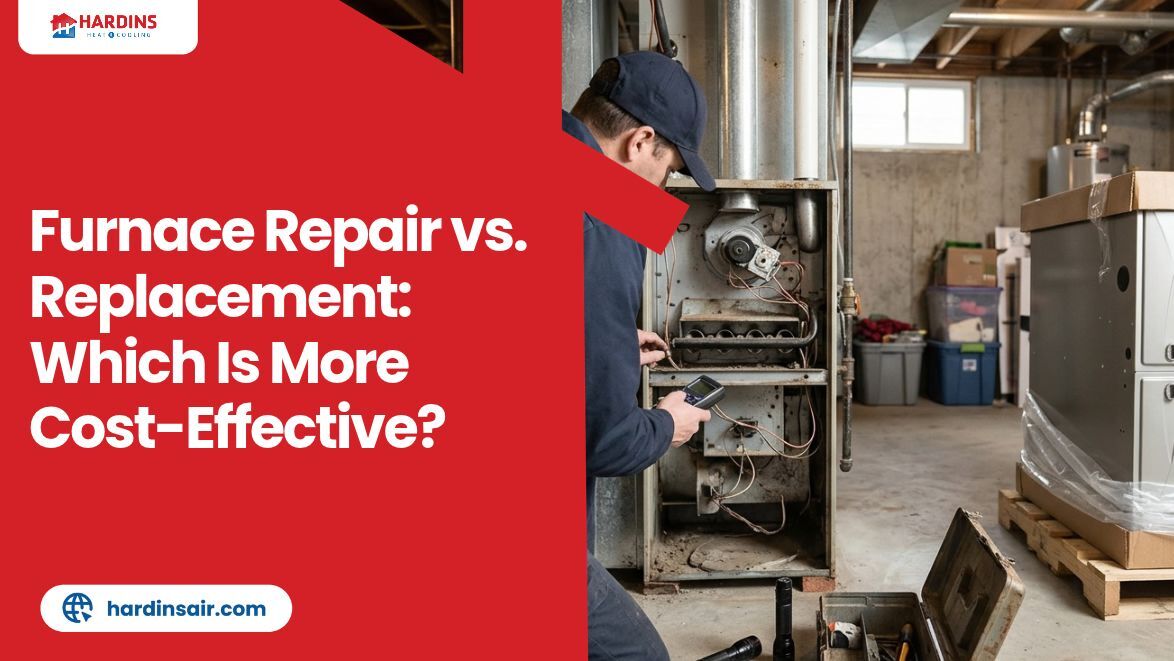
Professional furnace repair is generally more cost-effective when the unit is relatively new, has a good maintenance history, and needs an isolated repair. Replacement may offer better long-term value when an older furnace requires repeated expensive repairs, has major component damage, or consumes significantly more energy than newer models. Compare actual repair and installation quotes before deciding.
Key Takeaways
|
Cost note: The prices below are general national estimates. Your final cost depends on the furnace model, the failed part, local labor rates and how easy the unit is to reach. IT is best to get a quote from a professional technician.
Is It Cheaper to Fix Your Furnace or Buy a New One?
Fixing a furnace almost always costs less upfront. Most repairs run a few hundred dollars, compared with several thousand for a new installed unit. Long-term value depends on the furnace’s age, the size of the repair and its recent service history.
Replacing a failed igniter on an otherwise well-maintained 8-year-old furnace will often be more economical than replacing the entire unit. The math changes on an 18-year-old unit that needs a $1,200 blower motor. That money may only cover one or two more winters.
When Repair Is the Better Value
Repair is usually the smarter spend when most of these points describe your furnace:
- It’s under 10 to 12 years old. Most of its service life is still ahead of it. Putting money into a sound furnace protects the investment you already made.
- One small part failed. Flame sensors, igniters, capacitors, limit switches and thermocouples are common wear items. Replacing one of them doesn’t mean the rest of the system is failing.
- It has a steady service record. Yearly HVAC maintenance and tune-ups and few past breakdowns suggest the heat exchanger, motors and controls are in good shape.
- It still heats the whole house evenly. If the furnace maintained comfortable temperatures before the breakdown, that is a positive sign.
- The part is still under warranty. Many furnaces carry a parts warranty that lasts several years after installation. A covered part can cut the bill down to labor.
A furnace that meets most of these conditions may be a good candidate for repair, provided a technician confirms that its major components remain in serviceable condition.
When Replacement Saves More Money
Replacement becomes the better buy when your furnace shows signs like these:
- It’s 15 years old or more. Most furnaces last 15 to 20 years. Motors, switches and the heat exchanger wear faster as a unit gets close to that range.
- Repairs keep coming back. Repeated breakdowns, especially when they involve different major components, may indicate that the furnace is becoming less reliable. Review the repair history before deciding whether continued repairs are worthwhile.
- The repair is a big one. A new heat exchanger, gas valve or control board on an older furnace can eat up a large share of a new unit’s price.
- Its efficiency is low. The Department of Energy notes that older furnaces run at 56% to 70% annual fuel utilization efficiency (AFUE). Modern high-efficiency models reach 90% to 98.5%.
- Parts are hard to find. Older or discontinued models can need parts that take weeks to arrive or cost more than usual.
- The heat exchanger is cracked. Heat exchanger damage and furnace failure can become serious safety concerns because a cracked heat exchanger can compromise the separation between combustion gases and circulating household air. Have the furnace evaluated by a qualified technician and follow their safety recommendations. On an older furnace, replacement may be more practical than a costly heat exchanger repair.
How Repair History Changes the Math
Looking only at today’s quote can hide the real cost of keeping an old furnace. Past repairs and the years of service left both belong in the comparison.
Take a 14-year-old furnace that needed a $350 igniter and a $250 flame sensor service last winter. This year the blower motor failed with a $900 quote. That’s $1,500 in two seasons on a furnace with maybe three to five years left.
If a new furnace for that home costs about $5,000 installed, those two winters of repairs already equal 30% of its price. Higher gas bills from an older, less efficient unit push the comparison further toward replacement.
Now picture a 7-year-old furnace with a good maintenance history, and the same $900 blower motor repair presents a different situation. If its other major components are in good condition, repairing the motor may be more economical than replacing the entire system.
Keep a simple record of every service call and what it cost. The next time something breaks, you’ll have real numbers to compare instead of a guess.
How Much Do Furnace Repairs and Replacements Cost?
Most furnace repairs fall between $150 and $600. A full replacement costs many times more. That gap narrows only when a major part like the heat exchanger or blower motor fails.
The table below lists typical installed prices for common repairs and how often each one is worth fixing.
| Repair | Typical cost | Worth fixing? |
| Flame sensor cleaning or replacement | $80 to $250 | Usually yes |
| Igniter | $150 to $400 | Usually yes |
| Capacitor or limit switch | $100 to $450 | Usually yes |
| Control board | $300 to $1,000 | Depends on age |
| Gas valve | $250 to $1,000 | Depends on age |
| Inducer motor | $400 to $1,300 | Under about 12 years |
| Blower motor | $400 to $1,500 | Under about 12 years |
| Heat exchanger | $1,000 to $3,500 | Rarely past 15 years |
Heat exchanger work often settles the question. On a furnace past 15 years, this repair can cost a third or more of a new unit. Many technicians will suggest replacement at that point.
Most repair bills also include a service call or diagnostic fee, often $75 to $200. Evening and weekend visits can cost more.
For a full replacement, furnace installation for gas furnaces usually costs $3,800 to $10,000. Electric furnaces cost less upfront, often $2,000 to $7,000. They can cost more to run in areas with high electric rates.
What Raises the Price of a New Furnace
Two homes on the same street can get very different replacement quotes. These factors usually explain the gap:
- Size. Furnace output is measured in British thermal units (BTUs). Larger or draftier homes need more output and a bigger, pricier unit.
- Efficiency rating. A 95% AFUE condensing furnace costs more than an 80% model. It also burns less gas every month it runs.
- Burner and blower type. Two-stage and variable-speed furnaces cost more than single-stage units. They run more quietly and keep temperatures steadier. Read this comparison of single-stage and two-stage furnaces to understand their differences. This comparison of single-stage and two-stage furnaces covers the trade-offs.
- Fuel type. Switching between electric and gas heat can add gas line or electrical work to the job.
- Venting and drainage. High-efficiency furnaces vent through plastic pipe and need a condensate drain. An older home may need new venting to support one.
- Ductwork. Leaky, damaged or undersized ducts may need changes before a new furnace can perform as rated.
- Location. A furnace in an attic or tight crawl space takes longer to remove and install than one in a basement or garage.
Simple Rules for Making the Repair or Replace Decision
HVAC technicians and energy agencies use a few quick formulas to judge a repair quote. Treat them as starting points. A proper diagnosis and a written quote should still drive the final choice.
The 50% Rule
If one repair costs half or more of a new furnace’s price, replacement usually gives better value. Say a new furnace for your home would cost $5,000 installed. Any single repair at or above $2,500 is a strong reason to replace.
This rule works best for furnaces past the middle of their lifespan. On a 5-year-old unit, even a large repair can still be worth paying for. Ask for a replacement estimate first so you’re comparing against a real number for your home.
The $5,000 Rule
Multiply your furnace’s age in years by the repair cost. A result above $5,000 points toward replacement. Below that number, repair usually makes more sense.
Here’s how it plays out with the same $600 repair on two furnaces:
- 12-year-old furnace: 12 × $600 = $7,200. Replacement comes out ahead.
- 7-year-old furnace: 7 × $600 = $4,200. Repair is the better choice.
The formula is easy to run at home. It leaves out efficiency, safety and how long you plan to stay. Use it alongside the other checks covered here.
The 25% Guideline for Older Furnaces
The Minnesota Department of Commerce sets a lower bar for furnaces near the end of their life. Its home energy guide says spending 25% or more of a new furnace’s cost on repairs may signal that replacement is due.
The bar is lower because an older furnace has fewer years left to spread the repair cost across. On a $5,000 replacement, that line sits at $1,250 in repairs.
A 16-year-old furnace that needs a $1,400 gas valve crosses it, even though the repair stays well under the 50% mark.
Energy Savings: Can a New Furnace Pay for Itself?
A newer furnace can lower heating bills. The savings rarely repay its full price within a year or two. How fast you earn the money back depends on your current furnace’s efficiency and how cold your winters get.
AFUE shows how much of the fuel a furnace burns turns into heat. An 80% AFUE furnace turns 80 cents of each fuel dollar into heat. Moving to a 95% model cuts the waste from 20 cents to about 5.
Here’s a simple example. A home spends $1,000 a year heating with a 70% AFUE furnace. The same heat from a 95% furnace would cost about $740, a savings of roughly $260 each winter.
ENERGY STAR suggests looking at replacement once a furnace passes 15 years. Its certified furnaces are about 15% more efficient than conventional models.
The time needed to recover the additional cost of a high-efficiency furnace depends on the price difference between models, local gas rates, climate and the existing furnace’s efficiency. Compare estimated annual operating costs before deciding whether the higher upfront investment is worthwhile.
Your starting point matters too. Upgrading from an 80% AFUE furnace saves less than upgrading from a 60% unit. The payback period stretches out as a result.
Efficiency alone rarely justifies replacing a furnace that still runs well. It carries the most weight when you’re already facing a large repair on an older unit.
Many cost guides still mention a federal tax credit for new furnaces. According to the IRS instructions for Form 5695, that credit can’t be claimed for property placed in service after December 31, 2025.
Ask your gas or electric utility about current rebates before you buy. Rebate programs change often. Confirm the details before you choose a model.
Conclusion
Repair is usually more cost-effective for furnaces under 10 to 12 years old with one failed part. Replacement tends to win once a furnace passes 15 years, needs a repair close to half the price of a new unit or keeps breaking down.
Run the 50%, $5,000 and 25% checks with a real quote in hand. Then factor in safety, how long you’ll stay in the home and the age of your AC.
When you’re weighing a repair quote against the price of a new furnace, Hardin’s Heating & Cooling will compare both options with you. We’ll look at your furnace’s age, condition and repair history, then explain each option before any work begins. If replacement makes more sense, we can walk you through financing for a new installation too.