

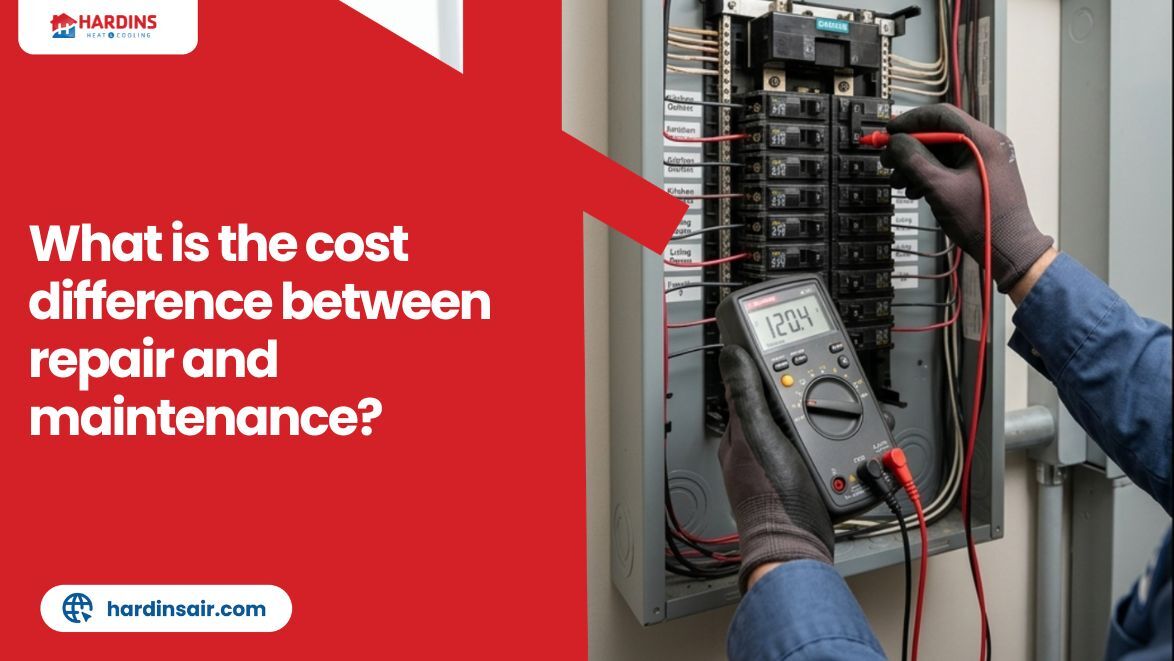
Most businesses and homeowners treat repair and maintenance as interchangeable until they get a repair bill that stops them cold. The two are not the same and the cost difference between them is not small. Maintenance is money you spend on your terms. Repair is money you spend on the equipment on its terms. Understanding that difference changes how you budget, how you plan, and how much you end up spending over the life of any piece of equipment.
Core Takeaways
- Maintenance is planned, predictable and almost always cheaper than the repair it prevents.
- Emergency repair labor rates run significantly higher than scheduled service rates for identical work.
- Deferred maintenance does not eliminate the cost. It delays it and adds to it through accelerated wear and compounding damage.
- The 50 percent rule gives you a reliable benchmark for deciding when repair stops making financial sense and replacement takes over.
- Tracking your maintenance versus repair spending over time is the clearest way to measure whether your current approach is actually working.
What Does Repair Actually Mean and When Does It Happen?
Repair is reactive. It occurs when something fails and requires corrective action. The trigger is always a breakdown, a component malfunction or a performance that has dropped below an acceptable level.
Repair typically happens when:
- The equipment stops functioning completely and operations cannot continue
- A component fails suddenly and shuts down the wider system
- Performance drops to a point where output quality is no longer acceptable
- A furnace repair call comes in because the unit stopped heating entirely rather than being serviced before the problem reached that point.
- Deferred maintenance finally catches up and a small ignored issue becomes a full breakdown
What Maintenance Covers and Why It Is Proactive?
Maintenance is scheduled work done to keep equipment running before anything goes wrong. The goal is to catch wear, identify developing issues and replace components on a planned timeline rather than waiting for a failure to force the decision.
Maintenance typically covers:
- Regular inspections to check for wear, leaks, corrosion or abnormal performance.
- Cleaning and lubrication of moving parts to reduce friction and extend component life.
- Replacing filters, belts, seals and other wear parts before they fail.
- Calibration and testing to confirm the equipment is operating within specification.
- Seasonal servicing such as preparing heating systems before winter rather than calling a furnace repair service when the unit fails in the middle of a cold snap.
Why Repairs Almost Always Cost More Than Maintenance
The cost gap between repair and maintenance shows up in more places than just the invoice.
- Emergency labor rates are often significantly higher than scheduled service rates, sometimes ranging from 50 to 100 percent more depending on location and timing. Furnace repair near me in the middle of January costs significantly more than a seasonal service call booked in October.
- Emergency parts often require expedited shipping at premium prices. When a component fails catastrophically, it frequently damages surrounding parts that turn one replacement into several.
- Unplanned downtime is the cost most people forget to calculate. Staff idle, orders delayed and customers lost often exceed the repair bill itself.
- Planned maintenance lets you control timing, parts ordering and labor costs. A repair gives you none of that control.
How Deferred Maintenance Drives Repair Costs Up Over Time
Skipping scheduled service feels like a cost-saving in the moment. It rarely is.
When Skipped Service Catches Up With You
A missed filter change leads to restricted airflow which makes the blower work harder. A blower running harder than it should puts extra load on the motor. That motor wears out faster than it would have with clean filters and proper airflow. None of this happens overnight but every skipped service visit moves the timeline forward on a repair that was otherwise avoidable.
How Wear Compounds Across the Whole System
Equipment does not fail in isolation. When one component is running outside its normal parameters, it creates stress on the components connected to it. A worn belt causes vibration that loosens fasteners. Low lubrication on one bearing increases heat that degrades nearby seals. By the time something fails visibly, the damage has usually spread further than the single component being replaced.
What Deferred Maintenance Actually Costs in Real Numbers
A standard annual HVAC service typically runs $100 to $200. A capacitor failure caught during that service costs $150 to $300 to fix at a scheduled visit. The same capacitor failing on its own mid-summer without warning brings an emergency call-out fee, after-hours labor rates and a potential compressor strain repair on top of the original part.
When Repair Makes More Sense Than Continued Maintenance
Maintenance is not always the right answer. There are situations where a repair makes more financial sense than continuing to service aging equipment.
The 50 Percent Rule for Repair vs Replacement
If the cost of a repair exceeds 50 percent of what a replacement would cost, replacing is almost always the better financial decision. Putting $1,500 into repairing equipment that costs $3,000 to replace means you are spending half the cost of a new unit to extend the life of an old one that is already showing signs of decline. At that ratio, the math rarely works out in favor of repair.
Age of Equipment as a Factor
Repairing a two-year-old piece of equipment is almost always worth it. The same repair on a twelve-year-old unit with multiple worn components is a different calculation entirely. Older equipment is less efficient, harder to source parts for and more likely to need another repair within the same year. Age does not automatically mean replace but it changes the weight you put on a repair decision significantly.
When a Repair Is a One-Time Fix vs a Recurring Problem
A single repair on a well-maintained piece of equipment is normal. Two repairs on different components within the same season is a pattern. When multiple parts start failing around the same time, it usually means the equipment is at the end of its useful life and the next repair is already developing somewhere in the system. Continuing to maintain and repair equipment at that stage costs more over the next two years than replacing it now.
How to Build a Maintenance Budget That Prevents Emergency Repair Costs
A realistic maintenance budget removes the financial surprise of emergency repairs. Here is how to build one that actually works.
- Set aside 1 to 3 percent of equipment replacement value annually for maintenance costs.
- Schedule service visits before peak demand seasons, not after something breaks.
- Track every repair cost separately from maintenance spend to see the real cost difference over time.
- A service contract locks in labor rates and priority response before you need emergency help.
Read Also: Why is my heating and cooling system not working properly?
Conclusion
The cost difference between repair and maintenance is not close. Maintenance is predictable, controllable, and almost always cheaper than the repair it prevents. Every skipped service visit moves you closer to an unplanned breakdown that costs significantly more than the visit would have. Do not wait until something stops working to take equipment health seriously. Contact Hardin’s Heating and Cooling to get your equipment serviced before the next breakdown finds you first.
FAQs
Is maintenance always cheaper than repair?
Mostly. The exception is minor repairs on well-maintained equipment that are caught early and fixed quickly. Once a failure becomes an emergency with after-hours labor and expedited parts, maintenance is cheaper in every realistic scenario.
How much should a business budget for equipment maintenance?
A commonly used benchmark is 1 to 3 percent of total equipment replacement value per year. A business with $50,000 in equipment should expect to spend $500 to $1,500 annually on maintenance to prevent repair costs from climbing significantly.
What is the 50 percent rule in repair vs replacement decisions?
If a repair costs more than 50 percent of what a replacement would cost, replacing is almost always the smarter financial decision.