

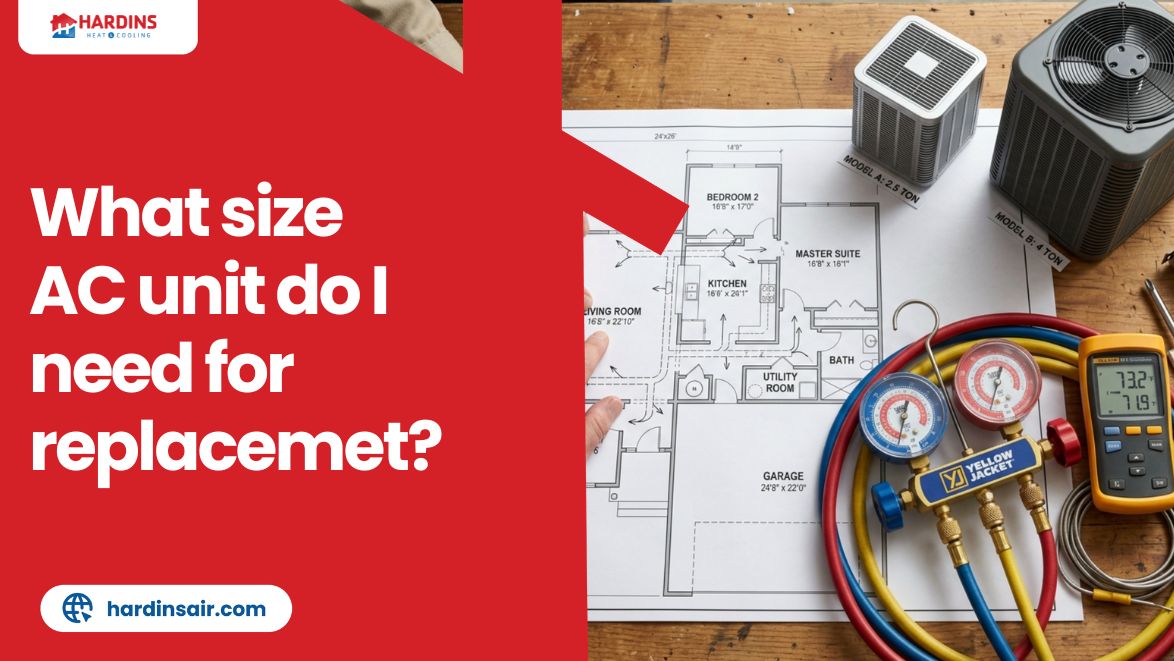
Summer heat hits hard and a struggling AC makes life unbearable. You might think replacing your old unit means matching its size exactly. But that assumption could cost you comfort and money down the road. So, how do you determine the right size AC unit for a replacement?
| Quick Answer
A professional load calculation determines the exact size your home needs properly. Square footage, insulation quality, window size, climate, and number of people all affect sizing decisions. Unfortunately, installing the wrong size results in poor comfort, wasted energy, and premature breakdowns. Don’t just match your old unit size blindly. Get an expert evaluation to ensure perfect performance and efficiency for years ahead. |
Understanding AC Sizing (BTUs Explained)
AC size isn’t about physical dimensions it’s about cooling power measured in BTUs or tons. One ton equals 12,000 BTUs per hour of cooling capacity. Understanding this helps you grasp why bigger isn’t always better for your home.
- BTU means British Thermal Unit, the energy needed to heat one pound of water by one degree.
- Most homes need 20-30 BTUs per square foot depending on conditions.
- Common sizes include 1.5 ton (18,000 BTUs), 2 ton (24,000 BTUs) and 3 ton (36,000 BTUs).
- Oversized units cool too fast without removing humidity properly from your air.
- Undersized units run constantly, wearing out quickly while failing to cool your home.
Think about it. You don’t want swampy air that feels cold but sticky. That’s what happens when your AC is too large for your space.
Key Factors That Determine the Right AC Size
Your home is unique and several factors work together to determine the perfect AC size. Let’s break down what matters most when you’re planning an AC replacement.
Home Size (Square Footage)
Square footage is the starting point for AC sizing fundamentals. Larger homes need more cooling capacity to handle the air volume. A 1,500 sq ft home typically needs 2-2.5 tons of cooling power. Meanwhile, 2,500 sq ft requires 3-3.5 tons of capacity instead. But size alone doesn’t tell the whole story here. Other factors matter too when determining your exact needs.
You might have a small home with poor insulation needing more power. Or a larger home with excellent insulation needing less capacity overall.
Ceiling Height
Standard ceilings are 8 feet, but higher ceilings mean more air volume to cool effectively. Vaulted ceilings or 10-foot ceilings add cubic feet the AC must handle daily. That’s why homes with tall ceilings often need larger units than similar square footage homes with standard ceilings.
Consider a room with 12-foot ceilings. It has 50% more air than the same room with 8-foot ceilings. Your AC needs to cool all that extra air volume properly.
Climate Zone
Homes in hotter regions need more cooling capacity than those in mild areas. If you’re searching for an AC replacement near me in Oklahoma, factor in our brutal July and August temperatures. These months push AC systems harder than any other time of year.
Our state sees temperatures regularly exceeding 100°F during summer. That heat stress demands proper sizing for your system to handle the load.
Insulation Quality
Good insulation keeps cooled air inside and hot air outside your living space. Poor insulation lets cool air escape, making your AC work harder constantly. Recent insulation upgrades might mean you need a smaller unit now. Old homes with minimal insulation often need larger capacity to maintain comfortable temperatures throughout.
Think about your attic insulation. If it’s been there for twenty years, it’s probably compressed and less effective. That means your AC fights harder to keep things cool inside.
Window Size & Sun Exposure
Large windows, especially facing south or west, let in damaging heat daily. Double-pane windows block more heat than single-pane windows do. Homes with lots of sun exposure need extra cooling capacity regularly. If you’re doing an AC replacement in Yukon, consider how many windows face the afternoon sun. Also consider their size and how much glass your home has total.
A big west-facing window in July is like an open oven door. That heat loads right into your home and your AC must remove it.
Appliances & Heat Sources
Kitchen appliances, furnaces, indoor pools and hot tubs add significant heat loads. A busy kitchen with ovens and dishwashers raises indoor temperatures noticeably. Homes with these heat sources need larger AC capacity overall. Consider all heat-generating equipment when determining size, not just the AC unit itself.
A gas stove, oven running for dinner and refrigerator all produce heat. Your AC must remove all that heat plus the heat from outside.
Quick AC Size Chart (General Guide)
While professional calculation is best, this chart gives rough estimates based on square footage alone. Use it as a starting point, not a final decision for your home. Every home differs, so treat these numbers as general guidance rather than exact requirements.
| Square Footage | AC Size (Tons) | BTUs Per Hour |
| 1,000-1,200 sq ft | 1.5-2 tons | 18,000-24,000 BTUs |
| 1,200-1,500 sq ft | 2-2.5 tons | 24,000-30,000 BTUs |
| 1,500-1,800 sq ft | 2.5-3 tons | 30,000-36,000 BTUs |
| 1,800-2,200 sq ft | 3-3.5 tons | 36,000-42,000 BTUs |
| 2,200-2,800 sq ft | 3.5-4 tons | 42,000-48,000 BTUs |
| 2,800+ sq ft | 4+ tons | 48,000+ BTUs |
These numbers assume average insulation and 8-foot ceilings. Adjust up if your home has poor insulation or high ceilings.
Common Mistakes Homeowners Make
Many homeowners guess at AC size or just match their old unit blindly. These mistakes cause comfort issues, wasted money and early system failure regularly. Understanding what goes wrong helps you avoid costly errors during your replacement project.
- Assuming the same size as the old unit is automatically correct for your home.
- Going bigger without calculation, thinking more cooling capacity is always better.
- Ignoring home changes like insulation upgrades or room additions over the years.
- Skipping professional load calculation to save money upfront quickly.
- Using only square footage without considering other important factors.
- Buying based on price alone, ignoring proper sizing for efficiency.
- Not checking if ductwork matches new unit capacity properly.
Think about the cost of running the wrong size for ten years versus getting it right once. The calculation cost is tiny compared to energy waste and early replacement.
Importance of Professional Load Calculation (Manual J)
Manual J is the industry-standard method for calculating exact AC size accurately. HVAC professionals use it to measure every factor affecting your home’s cooling needs completely. This calculation costs little but saves thousands in energy bills and premature replacements easily.
- Manual J measures square footage, ceiling height, window size and insulation quality precisely.
- Accounts for climate zone, sun exposure, occupants and heat sources thoroughly.
- Calculates exact BTU requirement for your specific home conditions uniquely.
- Prevents oversizing, causing humidity problems and undersizing, causing constant running.
- Required by most HVAC manufacturers for warranty validation and coverage.
- Takes 1-2 hours but ensures perfect sizing for maximum efficiency.
- Only certified technicians should perform this calculation properly and accurately.
This isn’t just a recommendation. It’s the difference between a system that works properly and one that disappoints.
Read Also: How do professionals install an air conditioning system?
Conclusion
Finding the right AC size for replacement isn’t about guessing or copying your old unit blindly. Your home’s square footage, insulation, windows, climate, occupants and appliances all determine the perfect capacity needed. Going too big causes humidity issues while going too small means constant running and poor comfort daily.
The only way to know exactly what you need is a professional Manual J load calculation performed correctly. This ensures your new system runs efficiently, keeps you comfortable and lasts for many years ahead. Don’t risk costly mistakes with wrong sizing that wastes money and causes discomfort regularly.
Contact Hardin’s Heating & Cooling for expert AC replacement services. Our licensed technicians perform precise load calculations and install the perfect size unit for your home uniquely. Call today for professional service you can trust completely.
FAQs
Can I replace my old AC with the same size unit?
Not necessarily under most circumstances. Your old unit might have been wrong-sized originally when installed years ago. Or your home has changed since that installation happened. Insulation upgrades, new windows, or added rooms alter cooling needs significantly over time. Getting a fresh load calculation ensures you choose the correct size properly.
What happens if my AC is too big?
An oversized AC cools too quickly without removing humidity properly from indoor air. Your home feels cold but damp and uncomfortable constantly. The unit also cycles on and off frequently, wasting energy and wearing out faster naturally. You’ll pay more for comfort that feels uncomfortable and sticky inside.
How many square feet does a 1.5 ton AC cover?
A 1.5 ton AC with 18,000 BTUs typically covers 1,000-1,200 square feet in average conditions. But ceiling height, insulation, windows and climate affect this range significantly. Homes with poor insulation or lots of sun might need a larger capacity for the same space easily.